Translate

Showing posts with label spain. Show all posts

Sunday, 22 December 2013

20131221 - ISON Not Found + the start of a theory

Over the past few days two famous telescopes have been looking for C/2012 S1 ISON.

The Arecibo (the world's largest Radio Telescope in Puerto Rico) reported yesterday that they had found nothing. 

The Hubble Telescope reported late yesterday that they had found no trace of it. Here is a link to their results.

There may be a few bits around, but they would be less than 150 meters in size.

So there is no need to throw any life rafts, Just wreaths :( 

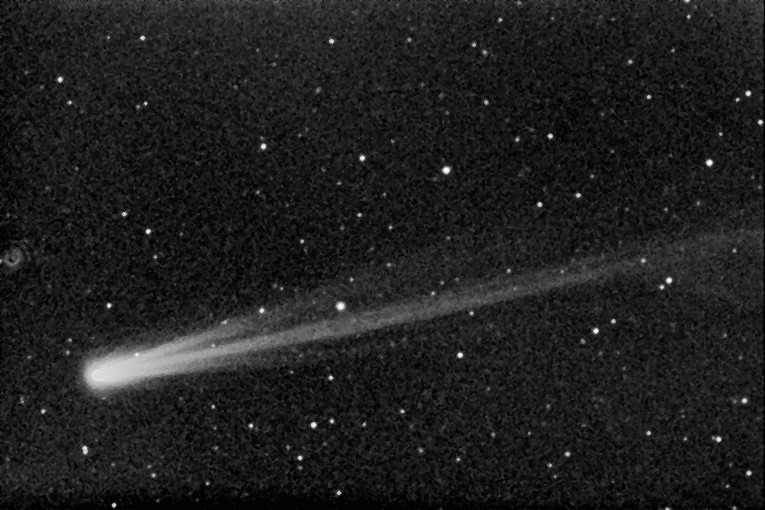
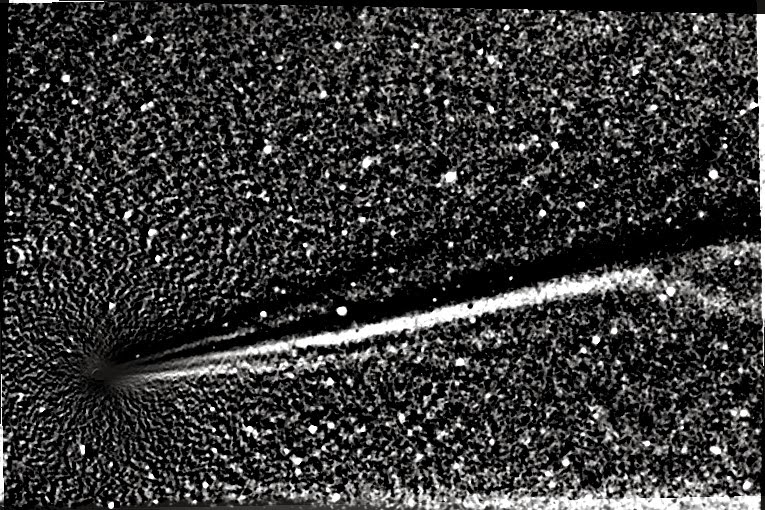
Why and when ISON started to break up is now the question that is being asked and various theories, which need to be tested, are being put forward. My personal theory - unproven - is that sometime in the lead up to the 13th November (perhaps a day or two before) the nucleus of the comet started to become unstable, whether a chunk broke away or it started to crack I do not know. The visible effect is shown in this image that SON@OSC took on the morning of the 13th November. If you look a third of the way along the lower tail you can see a discontinuation. +Padma Yanamandra-Fisher  picked up on this event as soon as she saw the image.


Over the next few days the comet physically changes as can be seen in the following image from the morning of the 15th .

The following day, the 16th, it seems calm down a bit (through cloud).


Morning of the 19th through thin cloud again!


The next event was noticed on the morning of the 22nd. +Charles Bell  pointed this out to me. towards the end of the displayed lower tail there is a branch off - looks like half a feather on an arrow. I think that a day or two before there was another major fracture to the nucleus.


This was the last time I saw ISON . I think by this time the nucleus was fatally flawed and came apart during its near encounter with our Sun.


It is important to recognise that the images of ISON represent only part of the history of the comet. They are, of course, an important resource, especially if and when other images can be added to the time line. I still have a number of images to process and perhaps some of those will add to the story.

Other data now needs to be brought together and analysed. A lot, but not all, of this data has either been captured by amateurs or is in the public domain. A number of amateurs have already started modelling this data, some of which at first glance supports my idea. Until I fully understand this data (and other data), myself I will not present it and only then with permission.

I will be looking to see what the professionals come up with. One thing about of astronomy is that there is always something new to learn.

Finally

After a cloudy night, this morning I managed to finds some holes in the clouds and brought the cameras into focus and at dawn take some flats.

Late afternoon we struggled up the observatory hill with the framework for the new roll off observatory to house the new telescope.

This evening is cloudy again :( which was disappointing as Search Light Observatory Network had received a request to record a stellar occultation which would been taking place now. Alas the observatory hill is covered with a damp cloud.

Friday, 20 December 2013

20131220 - All change in the Observatory

As I mentioned in the previous Blog it is time for exoplanets again.

What is an exoplanet (or extrasolar planet)? It is a planet that is in an orbit around a star other than our own Sun :)

I received a few days ago, along with the other Searchlight Observatory Network Observatories, the agreed list of targets and time table from Professor +Svetlana Berdyugina at Kiepenheuer-Institut für Sonnenphysik .

Svetlana has been observing exoplanets for a number of years. It was Svetlana and her team that discovered, a number of years ago, that a planet (HD 189733b) in orbit around HD 189733 is blue. This was later confirmed this year by Hubble observations.

There are a number of different ways to discover and monitor exoplanets. The current project involves known exoplanets using a technique called Exoplanet Transits. This only works with systems that are near to edge on to us. The observation process involves measuring the change in brightness of the host star when an explanet passes in front of it. The techniques involved are similar to those used for variable star observing. I will write, in the near future, a number of Blogs covering the various methods of discovering and monitoring exoplanets :).

Ideally I should have changed the telescope configuration and started some test runs a few days ago, but after a few months of overall good observing nights the weather changed. We have had clouds, we have icy rain and lots of interuptions with the power.

Yesterday's driving rain stopped me from opening the observatory so with the alarm set early I went up to the observatory to check it out. Apart from a few small wet spots and the need to reset the power everything was OK. It was still fairly cloudy but with holes so I managed to see some stars for the first time in days. It was not suitable for imaging properly but decided to take some images of Comet Lovejoy before changing the configuration.


After these were taken it was time to start to change the configuration.

For the past couple of months the ST8 CCD Camera along with its filter wheel has been on the 4" F4 Pentax refractor and the ST7 CCD Camera was on the C14 F11 SCT.

I now needed to swap the cameras over and also reduce the focal length of the C14 by putting in a focal reducer and once done rebalance the telescope and check that the cable will not get tangled up, (four power cables and four data cables!).

That is the easy bit done! The sky or should I say the clouds stopped most other things being done until this evening and daybreak - providing that it is clear.  So hopefully I will be able to refocus the two telescopes and take new sets of dark, flat and bias frames.

N.B. For none astronomers I promise to do a Blog posting in the next few days explaining the reasons why I needed to change the configuration and what are the effects.

There are a number of jobs I can do during the day, some of which are already under way, including producing an observing timetable.

It is now starting to get dark. There are thick clouds on the horizon and thin cloud overhead. Providing the cloud overhead does not get much thicker I will be able to finalise the configuration, otherwise it will be the case of getting up at four in the morning to check if the cloud has gone and if it has to do the finalisation then.

As there will not be much to show image wise with exoplanets, I will be showing images of various objects that I have yet to process, or will be able to take when exoplanet observing is not taking place.

Other work in progress

I am in the middle of getting another observatory up and running. I have building a roll off structure for it and late afternoon we got it up to the observing area ready for cladding. Pictures tomorrow.

The other day

I mentioned in the previous Blog that a drop in power stopped the telescope mount from working for an hour or so. What I did not mention was that the computer and cameras did not stop.

The following image was taken at ten o'clock at night with just moonlight. It will give you an idea of the power of the telescope (4" refractor) and a time controlled CCD camera :) The distance to the buildings is about three miles.


Monday, 16 December 2013

20131216 - ISON - Search and Rescue appears to have failed.

For the past few weeks, very much like when a yacht has been reporting missing, search and rescue have been out looking for this comet in distress.

At the beginning dozens, if not hundreds, of telescopes and binoculars swept the area of sky where the deathly remains of ISON hopefully could be found - but only if the remains were either large or dense enough to be seen.

There were a number of potential sightings by very experienced observers, though these potential sightings were always accompanied with health warnings. There was even a "sighting" report being circulated where someone had misunderstood the date format of a report which was of an earlier observation of the comet.

Everyone of these sightings needed to be followed up .... just in case someone has actually found the wreckage. Like most, I prefer for observers to post potential sightings, than for them to be sat on because of a concern of being wrong. There is always the danger though that they will get picked up by the media and misinterpreted - as is often the case, but we should never allow that to stop us making reports.

One of the good things about amateur observations are that they are distributed as soon as possible. Amateurs know that by putting out these possible sightings they may be able to be confirmed by someone in another Time Zone, before the object(s) have completely left, or are in the vicinity of that field of view.

Soon I expect the obituaries will start to be published telling us as much as possible about the life and death of ISON with the coroners verdict of Lost at Sea - sorry Lost in Space. As with all celebrities, much more will be written and published as more facts are discovered about ISON's life.

We only got to know her in her final years of life and know little of her childhood spent somewhere in the little know Oort cloud.  Someday in the distant future a little of what remains may arrive back at her original home.

                               -------------------------------------------------

I suspect that on posting this, within a day or two there will be more reports of seeing it, but as in real life there will be less suitable resources available to check.

From now on my time will be split, with Exoplanet Transits taking priority, but there will still be plenty of time for comets and other objects :) . This means that future Blogs will cover more subjects, including progress on a new SON observatory.

Wednesday, 11 December 2013

20131211 - A catch up on comet images

As I mentioned in the last post, the reaon for lack of entries it is not that nothing has been happening, but the reverse!

A comment to the previous post exclaimed surprise at the time that processing the images take.

Let us go through a simple outline processing the comet images that I now follow. I will cover an observing run another time.

OK then, I have finished and observing run and closed down the observatory. What next?

On the computer there may be as many as 500+ images from the observing run all held in a directory named after the evening before's date in reverse order. Today is the 11th December 2013, so the observing run that could have started yesterday evening and finished at daybreak today so the directory would be named 20131210.

I then create a number of subdirectories named after the objects I have imaged. Where I have imaged the same object in two different ways then I create two subdirectories. Into these subdirectories I copy the various groups of files. There could be up to a hundred or more image files in each subdirectory.

The images in each of the subdirectories need to be reduced (or calibrated). Data reduction This is to take out inconsistencies. If you want to read more about it here is a link that explains the basics. The reduced files are put into a subdirectory - we do not overwrite the original files as we need to keep these.

After this has been done what happens next depends on what type of observations have taken place on different classifications of objects.

I will now describe what I do for single framed images of comets. My starting point is a folder of reduced images of a comet. There maybe 100 images and at a quick glance you would think that they are all the same, but there are not. A comet is moving against the background of stars. If we looked at each of the images carefully you would note the comet, especially as it gets nearer to the Sun will be in a slightly different position against the stars.

We are interested in the comet - not the stars. Let us say that each of the images is a 10 seconds exposure. We have a hundred and we need to overlay each of the images so that the comet overlays itself and not the stars. A number of programmes can do this, but I have not found one better than Astrometrica . Not only can it stack the comets - called Stack and Track the programme can many other things including astrometery and photometry (where is it and how bright is it).

This exercise leaves me with a single combined image that I can save and its brightness (magnitude).

I can now load this image into another programme and prepare it for submission.

At the moment some of the images are shown here, sent to the British Astronomical Association, shown in a few Facebook groups including Comet Watch and CIOC_ISON and also shortly to the University College London.

We do not delete any of the observations because you do not know when they may be of use. A good example is the UCL where I will be going back in time to find images that meet their needs.  


Here then is a gallery of some of the images taken since the last images until the 7th December:


SON@OSC (Searchlight Observatory Network at the Observatorio Sierra Contraviesa, Granada, Spain)
Observers Tony Angel and Caisey Harlingten
4" F4 Refractor ST8 Clear bin 1x1
FOV 115.5 x 77.7 arcmin
North at top

C/2013 R1 - Lovejoy - 2nd December

C/2013 R1 - Lovejoy - 2nd December
5th December

C/2013 R1 Lovejoy - 5th December

C/2012 R1 Lovejoy - 5th December
6th December

C/2012 R1 Lovejoy - 6th December

C/2012 R1 Lovejoy - 6th December
7th December

C/2012 R1 Lovejoy - 7th December

C/2012 R1 Lovejoy - 7th December

C/2012 X1 Linear - 7th December

C/2012 X1 Linear - 7th December

C/2013 V3 Nevski - 7th December

C/2013 V3 Nevski - 7th December


Monday, 25 November 2013

C/2013 R1 Lovejoy and its tail Today

I had meant to be publishing a few of yesterday's images of Lovejoy - those will have to wait :) When I saw how the imaging of today's Lovejoy was going I thought yes - another Tail :)

Composite taken 25/11/2013 at 05:51:22.625 and 05:58.53.968 GMT (UT)
Purposely over exposed to show tail.
Each image FOV 116.5 x 77.7 arcmins - north is up.
SON@OSC (Searchlight Observatory Network at the Observatorio Sierra Contraviesa, Granada, Spain)
4" Pentax Refractor at F4, SBIG ST8 with clear filter. 1 minute exposure binx2 Observers Tony Angel & Caisey Harlingten

Little text today - so just enjoy :)


Sunday, 24 November 2013

Clouds stopped play - apart from Friday

When the low clouds come in, as they did for most of he past week, it can be very frustrating in some ways, to see on The Net  images of the ever changing C/2012 S1 ISON, but it is exciting as well. Yesterday morning the clouds cleared, and I was able to take about three hundred images of Comets Lovejoy and ISON. This is about three to four times as many as I would normally take, the reason being is that with both comets being so bright now, it is no longer possible to take nice easy long exposures. Lots of short exposures means lot more work, so there will only a few to show today. This morning was particularly frustrating. Both ISON and Encke were in the same field of view, but again low cloud came in. The cloud was very thin, but because I was observing just above the horizon, the effect of trying to image through miles of thin cloud is as bad as trying to image through thick cloud. The first image from yesterday is one of a series that I took mainly to check on whether it was time to start serious imaging. Here is C/2012 S1 ISON just above a field of grape vines. If you look at the tree near the bottom it will look as though it is leaning. It is not. The field is not that steep! The image is at an angle, because the camera is always orientated so that one of the image sides is always pointing towards the Pole Star.
Below I have rotated the image so that is near the correct orientation.

I had actually started imaging a little bit early and when I get the time I will display the sequence.
Soon the comet was high enough to take reasonable images of it. Here is the best I took on Friday morning. Below you will see the negative which always shows more detail. Look at the right hand edge and the lower part of the tail.
You can see it below clearer.
and here is a blow up of the right hand edge.

Below I used a utility that makes the image look 3D. It is called a Rotational Gradient. This really highlight a disruption to the tail. One word of warning. When you start "playing" with an image whilst quite often bringing out some detail, it is also destroying other details. I always keep the original image safe and create copies to work on. It is always best to display the original image as well as the worked on one, so as not to cause confusion. 


The above images were all taken using the 4" Pentax F4 Refractor. using the ST8 CCD Camera.At the same time I was taking images with the 14" C14 and the ST7 CCD Camera. I was using this to capture the head or coma of the comet. I have still not processed most of them, but below is one image.


All I have shown here are some of the ISON images. We also took a number of images of C/2013 R1 Lovejoy. I will start processing these shortly and then show them here, hopefully on a page that I can get the formatting to work how I want :)


v

Wednesday, 13 November 2013

ISON and feeling happy :)

Just woke up from my siesta (well I did make do with just four hours last night) and saw on the CIOC_ISON Facebook Page :

ALERT: images from earlier today: from Tony Angel:
 maybe outburst - please image, take spectra ??
 Thanks Tony for the quick alert.... Thanks, Padma Fisher

CIOC_ISON: is the Pro-Am Collaboration for Support of NASA Comet ISON Observing Campaign (CIOC) via Social Media.

Click here to read Padma's article or visit the NASA Comet ISON Observing Campaign

I do know that I was not the only person to pick this up, but it still feels good :)

Special on ISON - Observation from this morning.

C/2012 S1 ISON . this morning 13/11/2013 at 05:30 GMT SON@OSC 4" refractor F4 ST8

The two tails are like searchlights - both of similar dimensions and brightness (or I might be talking a load of rubbish)

FOV 116.5 x 77.7 arcmins

Please note that this was a quick and dirty process so that anyone who is just about to start their observing run can have an idea what to look for :)


Observations of Tuesday morning 11/11/2013

Written 12/11/2013 started whilst observing.

Not sure which is more stressful; chasing the comets to image before dawn, processing the most interesting images or thinking of what to write on here :)

Certainly chasing the comets is getting more hectic as drop lower in the sky and it becomes a race to beat dawn.C/2013 R1 Lovejoy is bright and high in the sky, in fact I realised after the fact that I need to look at bringing down the exposure time for Lovejoy.  C/2012 S1 ISON is still high enough to get reasonable images, but 2P/Encke and C/2012 X1 Linear are getting quite difficult.  Today will be the last time I will try - if I have time - for a colour image of Encke and Linear.

All images were captured using the SON@OSC Observatory (Searchlight Observatory Network) 4" Pentax F4 Refractor and an ST8 CCD camera

Here are some of yesterday's images.

The t(r)ail on Encke is still very distinct and some 150 arc minutes of it are visible

2P/Encke
2P/Encke

Linear is getting quite faint, especially now dawn approaches. It is still possible to see the what is left from the recent outburst. 

C/2012 X1 Linear
C/2012 X1 Linear

I expect that this will be the final colour image.

he
C/2012 X1 Linear

The second tail of ISON was first observed a couple of days ago. This was the first chance I have had to image ISON and capture the two tails.

C/2012 S1 ISON
C/2012 S1 ISON

The two tails of Lovejoy are quite clear. There seems to be, below the other two tails, either a third tail starting or a minor outburst. 
  
C/2013 R1 Lovejoy
C/2013 R1 Lovejoy

I will start the observing report of this morning's observations soon. The tails of ISON have changed so I will want to get an image on here soon. :)


Monday, 11 November 2013

Another tail - this time C/2013 R1 Lovejoy

Just a shot blog today (11/11/2013). As Lovejoy is now the brightest comet in the sky by far I thought I would see if how much of the tail I could image. It was soon obvious that the tail extended beyond the width of the image - some 115 arc seconds, so I took a second and third overlapping images and found that two overlapping images could pick up all the tail capable of being captured by the current SON@OSC set up for wide field imaging - 4" F4 Pentax refractor and an SBig ST8 ccd camera.

The following images are not pretty pictures - the aim is not for beauty but for detail. That is not to say you cannot have both beauty and detail - the images of @Damien Peach belay that idea, however in this instance I needed to really stretch the image to bring out the ion tail.

First Image - showing coma and tail


Second Image - showing tail


Third Image - no tail found


Joined images one and two together.


I have seen one other image that shows the unusual detail in the second image.

Comments are welcome :)

More on Friday Morning's Comets plus Saturday Morning's Comets - that quartet again!

On Friday 08/11/2013 I wrote a little about 2P/Encke and that day's imaging of it. Here are some other images I took that morning.

C/2012 S1 ISON


C/2013 R1 Lovejoy

C/2013 R1 Lovejoy Negative

C/2012 X1 Linear

C/2012 X1 Linear Crop


Saturday morning - 09/11/2013 - covered the Quartet - Again!.

First 2P/Encke. As there was a fair amount on interest in its trail I spent as much time as possible on imaging this before dawn came.

What follows are four versions of the same image. The first is the regular image. The second is the negative. The third is a stretched regular and the fourth a stretched negatve. In the final image you can really see the meandering trail.

2P/Encke

2P/Encke


2P/Encke


2P/Encke

Below is C/2012 S1 ISON.  This is still not developing very much, though I did see an image that was taken 24 hrs after this one and a second tail has now clearly appeared. I will be trying for this tomorrow morning.

C/2012 S1 ISON

C/2012 X1 Linear continues to be fairly bright after its outburst.

C/2012 X1 Linear

C.2013 R1 Lovejoy is really becoming the star of the show. It continues to brighten and is well ahead of ISON. Where as ISON is difficult to see in 10x50 binos, Lovejoy is now being seen with the naked eye.

I used four different method of processing Lovejoy to see if I could bring out more detail. I then stretched each one.

Process 1.


Process 2


 Process 3 


Process 4


All the images were taken using the Searchlight Observatory Network Observatory here in the Sierra Contraviesa, Granada, Spain at an altitude of 4,500 feet. The telescope used is a 4" Pentax F4 refractor and the camera is a SBig ST8 . All the images, with the exception of the cropped Linear are FOV 116.5 x 77.7 arcmins

There was no observing on the morning of Sunday 10th November due to my wife going to England for a week or two. I thought it would not go down too well to open the observatory while she was getting ready to leave :)

In the next blog I will include some objects that are not comets :)