Translate

Showing posts with label Comet Watch. Show all posts

Wednesday, 11 December 2013

20131211 - A catch up on comet images

As I mentioned in the last post, the reaon for lack of entries it is not that nothing has been happening, but the reverse!

A comment to the previous post exclaimed surprise at the time that processing the images take.

Let us go through a simple outline processing the comet images that I now follow. I will cover an observing run another time.

OK then, I have finished and observing run and closed down the observatory. What next?

On the computer there may be as many as 500+ images from the observing run all held in a directory named after the evening before's date in reverse order. Today is the 11th December 2013, so the observing run that could have started yesterday evening and finished at daybreak today so the directory would be named 20131210.

I then create a number of subdirectories named after the objects I have imaged. Where I have imaged the same object in two different ways then I create two subdirectories. Into these subdirectories I copy the various groups of files. There could be up to a hundred or more image files in each subdirectory.

The images in each of the subdirectories need to be reduced (or calibrated). Data reduction This is to take out inconsistencies. If you want to read more about it here is a link that explains the basics. The reduced files are put into a subdirectory - we do not overwrite the original files as we need to keep these.

After this has been done what happens next depends on what type of observations have taken place on different classifications of objects.

I will now describe what I do for single framed images of comets. My starting point is a folder of reduced images of a comet. There maybe 100 images and at a quick glance you would think that they are all the same, but there are not. A comet is moving against the background of stars. If we looked at each of the images carefully you would note the comet, especially as it gets nearer to the Sun will be in a slightly different position against the stars.

We are interested in the comet - not the stars. Let us say that each of the images is a 10 seconds exposure. We have a hundred and we need to overlay each of the images so that the comet overlays itself and not the stars. A number of programmes can do this, but I have not found one better than Astrometrica . Not only can it stack the comets - called Stack and Track the programme can many other things including astrometery and photometry (where is it and how bright is it).

This exercise leaves me with a single combined image that I can save and its brightness (magnitude).

I can now load this image into another programme and prepare it for submission.

At the moment some of the images are shown here, sent to the British Astronomical Association, shown in a few Facebook groups including Comet Watch and CIOC_ISON and also shortly to the University College London.

We do not delete any of the observations because you do not know when they may be of use. A good example is the UCL where I will be going back in time to find images that meet their needs.  


Here then is a gallery of some of the images taken since the last images until the 7th December:


SON@OSC (Searchlight Observatory Network at the Observatorio Sierra Contraviesa, Granada, Spain)
Observers Tony Angel and Caisey Harlingten
4" F4 Refractor ST8 Clear bin 1x1
FOV 115.5 x 77.7 arcmin
North at top

C/2013 R1 - Lovejoy - 2nd December

C/2013 R1 - Lovejoy - 2nd December
5th December

C/2013 R1 Lovejoy - 5th December

C/2012 R1 Lovejoy - 5th December
6th December

C/2012 R1 Lovejoy - 6th December

C/2012 R1 Lovejoy - 6th December
7th December

C/2012 R1 Lovejoy - 7th December

C/2012 R1 Lovejoy - 7th December

C/2012 X1 Linear - 7th December

C/2012 X1 Linear - 7th December

C/2013 V3 Nevski - 7th December

C/2013 V3 Nevski - 7th December


Sunday, 24 November 2013

Clouds stopped play - apart from Friday

When the low clouds come in, as they did for most of he past week, it can be very frustrating in some ways, to see on The Net  images of the ever changing C/2012 S1 ISON, but it is exciting as well. Yesterday morning the clouds cleared, and I was able to take about three hundred images of Comets Lovejoy and ISON. This is about three to four times as many as I would normally take, the reason being is that with both comets being so bright now, it is no longer possible to take nice easy long exposures. Lots of short exposures means lot more work, so there will only a few to show today. This morning was particularly frustrating. Both ISON and Encke were in the same field of view, but again low cloud came in. The cloud was very thin, but because I was observing just above the horizon, the effect of trying to image through miles of thin cloud is as bad as trying to image through thick cloud. The first image from yesterday is one of a series that I took mainly to check on whether it was time to start serious imaging. Here is C/2012 S1 ISON just above a field of grape vines. If you look at the tree near the bottom it will look as though it is leaning. It is not. The field is not that steep! The image is at an angle, because the camera is always orientated so that one of the image sides is always pointing towards the Pole Star.
Below I have rotated the image so that is near the correct orientation.

I had actually started imaging a little bit early and when I get the time I will display the sequence.
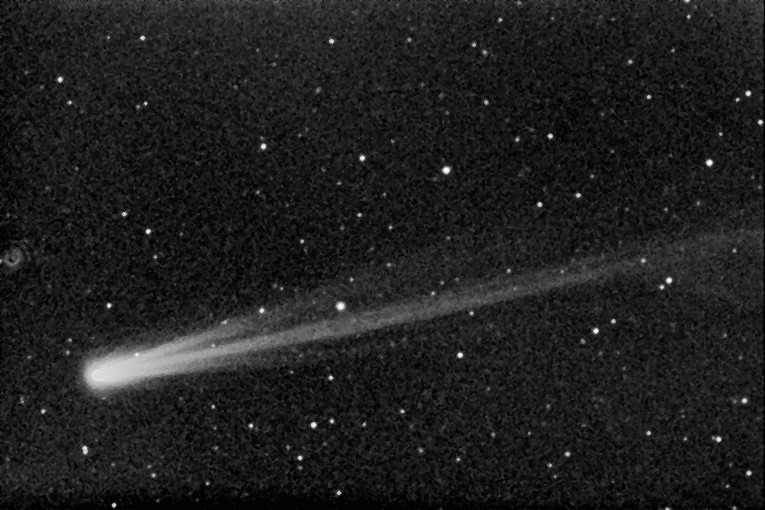
Soon the comet was high enough to take reasonable images of it. Here is the best I took on Friday morning. Below you will see the negative which always shows more detail. Look at the right hand edge and the lower part of the tail.
You can see it below clearer.
and here is a blow up of the right hand edge.

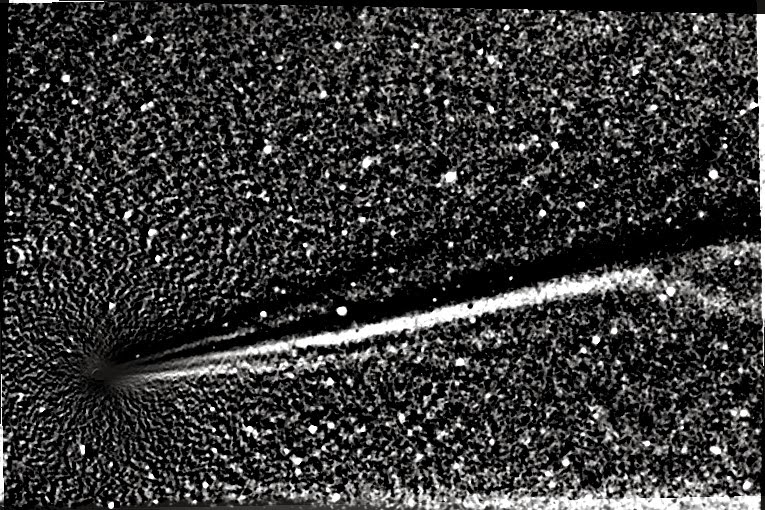
Below I used a utility that makes the image look 3D. It is called a Rotational Gradient. This really highlight a disruption to the tail. One word of warning. When you start "playing" with an image whilst quite often bringing out some detail, it is also destroying other details. I always keep the original image safe and create copies to work on. It is always best to display the original image as well as the worked on one, so as not to cause confusion. 


The above images were all taken using the 4" Pentax F4 Refractor. using the ST8 CCD Camera.At the same time I was taking images with the 14" C14 and the ST7 CCD Camera. I was using this to capture the head or coma of the comet. I have still not processed most of them, but below is one image.


All I have shown here are some of the ISON images. We also took a number of images of C/2013 R1 Lovejoy. I will start processing these shortly and then show them here, hopefully on a page that I can get the formatting to work how I want :)


v

Tuesday, 19 November 2013

Its been a funny couple of days.

The two main comet Facebook Comet Groups I belong to - CIOC_ISON and Comet Watch - have been suffering from a shortage of current images over the past few day. Many of us have been clouded out - even though we are fairly scattered around the world.

I did manage to rescue some LRGB images from Saturday morning, but they were shot through cloud layers, which produced unusual results. I displayed one of them on Neil Norman's Comet Watch and was surprised by the positive response - I think partially because we were getting withdrawal symptoms and anything new to do with ISON helped.


On Sunday I messaged Petri Kehusmaa ,who is responsible for the SON New Mexico Observatory, asked if he could take an image of ISON for me to share with the groups and he came up trumps, even though it was hitting the limits of his local horizon, and he had to wait until just before dawn.. What I also did not know at the time was the operational telescope had not yet had First Light. Here is Petri's First Light image of Comet ISON:


The weather now seems to changing and over the past half day more images are starting to come in.

Sunday Evening saw the broadcast that I did a prerecorded interview for and +Padma Yanamandra-Fisher did live (brave lady), This was for Under British Skies on Astronomy.FM . If you missed it and would like to hear it then do not worry, a podcast will be available in a few days.

I had intended covering a recent discussion on whether Comet ISON is starting to fragment or not! That will have to wait for another day as I will soon be opening the observatory. The sky is fairly clear, so providing there is no last minute clouding we will capture some images of at least ISON,

Sunday, 17 November 2013

Nothing today but most certainly More of Yesterday the 15th November 2013

After a few hours sleep last night I went up to the observatory to open up. The ground was covered in ice and frost and the clamshell was covered in a coating of ice. I pressed the open button and nothing happened - the clams were frozen. Pushed up on one side to break the seal and it opened. That was in fact the highlight of the observing session. By the time I walked back down to the house and sat down at my desk had sat down the sky clouded over and for the next couple of hours only caught a few glimpses of C/2012 S1 ISON.

So back to yesterday.

After Wednesday I thought it would be a long time before such excitement would come around again. I was wrong!

I had opened up the observatory a little late so only spent a short time on C/2013 R1 Love joy, (note to self must get round to processing those images). Then onto C/2012 S1 ISON. After moving the telescope slightly I took a one minute exposure to check I had as much as possible on the frame.


I looked at it and thought where is the second tail. Looked again and saw that there were multiple tails. Quickly changed the setting to a 3 minute exposure and binned 3- (basically that means that a 3 x 3 square of pixels is treated as a single pixel - bigger pixels mean more light captured quickly). Started to take the image - 3 minutes gave me the chance to make a quick cup of coffee :) - the image downloaded and I thought Wow! What has happened to it?


I felt as though I was looking at an old woodcut or engraving. Just look at it and imagine if  it filled the sky as some great comets have in the past.

I sent this image along with a negative to CIOC_ISON for Padma to look at and also to Comet Watch for Neil.


Negatives are very useful as they are easier on the eye for seeing the detail. To say that when people saw this caused some interest, would be an understatement.

From downloading the image from the camera to it being up for people to view was achieved in about ten minutes.  This enabled people to react to the change, either discuss what was happening or assisting in preparing to follow up.

To achieve this speed I do have to keep the processing simple. Flat and Dark frames have been applied, the background normalised, the image slightly stretched to bring out detail, in this case rotated 180 degrees so that north is up and then first saved as a positive then a negative and finally uploaded to the sites.

If you are a serious comet observer then you may wish to join CIOC_ISON and you are a Facebook user then click on the link.

While doing this more images were needed and I set of a cycle of LRGB image taking. This involves the camera taking multiple images, rotating through clear, red, green and blue filters. Twenty seconds per image. That was when the cloud came in and only nineteen more images were taken.

It was time for a quick cup of coffee and then shutting the observatory.

Between answering and asking questions I processed four of the last set of images to produce a colour image. Because these were short exposures the coma (head) of the comet looks smaller and there is less detain in the tail.


You can though still see the multiple tails an yes the comet is green. During the rest of the day I continued to keep uptodate with the comet, taking part in a number of discussions and a number of other activities.

These activities including sending images to the Comet Section of the British Astronomical Association . Later in the day there was a report and ebulletin issued.

I also produced a montage based on the last seven days activity up to yesterday.


Although simple to put together it went down very well with all the people who saw it.

I was asked during the day for permission to display a number of the images on various websites. I may cover this in a later blog.

Finally I did a prerecroded interview with Paul Harper of  Under British Skies
and this will be broadcasted on Sunday.  Although I will be talking about the comet the interview I was first asked about what is Searchlight Observatory Network. I only hope that I get it right. :) For more on the comet there is at least one other person covering it and that is +Padma Yanamandra-Fisher and I expect that she will be the highlight of the show. Padma is responsible for the CIOC_ISON Group on Facebook.

The CIOC_ISON Group is an a forum to provide support for professional and amateur comet observers to: share, discuss and collaborate on observations of comet ISON, as part of NASA's Comet ISON Observing Campaign (CIOC).

Well that is the description!  but it is a lot more than that.

Detailed information about the CIOC is located at: http://www.isoncampaign.org/


I finally got to bed twenty four hours after last in it.